State of the School Districts: Collin County, TX
A fast-growth school market where the “best” district depends on the family decision
Summary Perspective
Collin County is one of the most important school-decision markets in the United States right now. It sits inside the Dallas-Fort Worth growth corridor, has become a major relocation destination for families, and includes some of the most visible suburban school systems in Texas: Allen, Anna, Blue Ridge, Celina, Community, Farmersville, Frisco, Lovejoy, McKinney, Melissa, Plano, Princeton, Prosper, and Wylie. This report focuses on traditional independent school districts because those are the public school systems most directly tied to residential attendance zones and home-buying decisions. Region 10 also lists Collin County charter operators, including Imagine International Academy of North Texas and Lone Star Language Academy, but those are not attendance-boundary districts in the same way.1
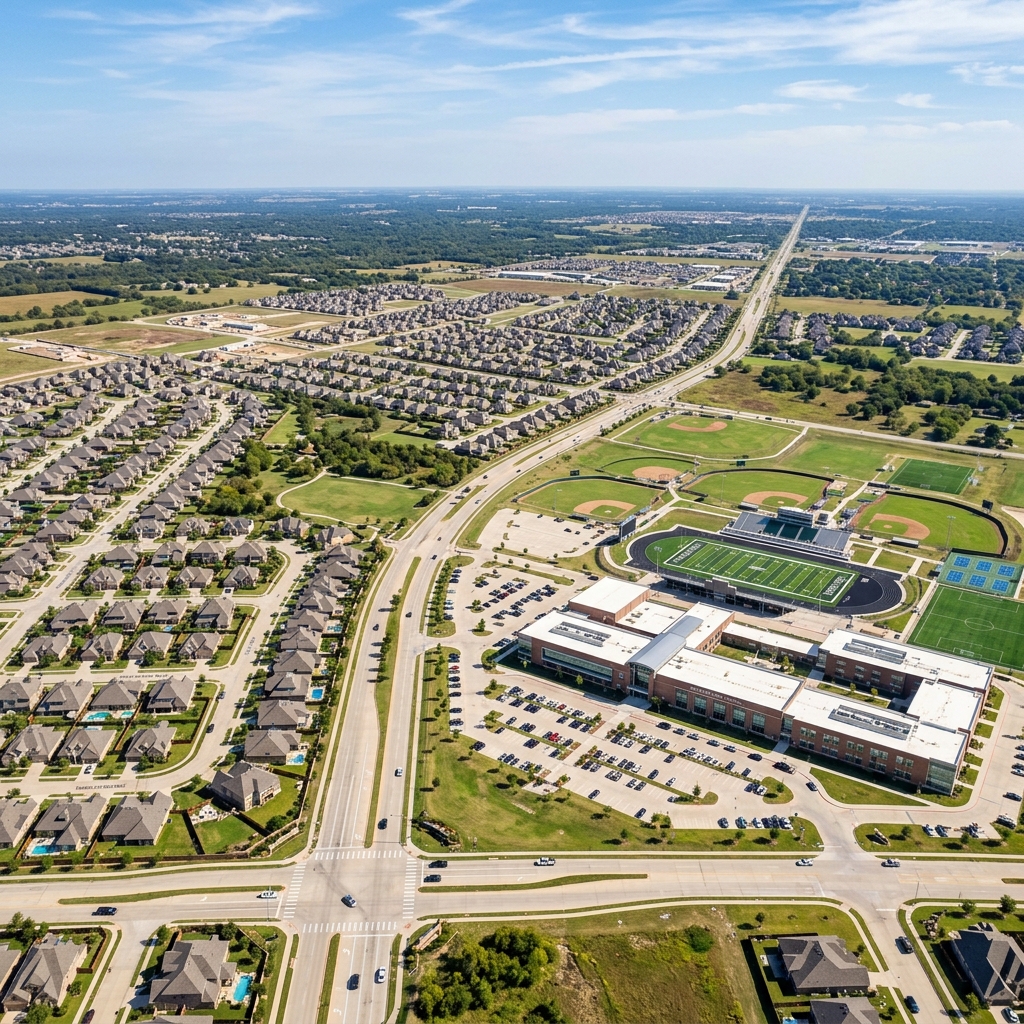
The county’s growth story is not subtle. U.S. Census QuickFacts lists Collin County’s July 1, 2025 population estimate at 1,297,179, up from a 2020 Census population of 1,064,465. The same source shows a 21.7% population increase from the 2020 estimates base to July 2025, and 24.0% of residents under age 18.2
That growth is not evenly distributed. Mature districts such as Plano ISD and Frisco ISD are dealing with enrollment slowdown or decline, while districts farther north and east, including Prosper, Princeton, Melissa, Celina, Anna, and Community, are managing rapid residential growth. Princeton has been described by the city and national reporting as the fastest-growing city in the United States from 2023 to 2024, with population growth of roughly 30% in one year.3
The central finding is that Collin County is no longer a single “good schools” story. It is three education markets operating at once.
First, there are large, established suburban systems with deep academic offerings and high performance, especially Frisco, Allen, Plano, McKinney, and Wylie. Second, there are premium fast-growth systems such as Prosper, Melissa, Celina, and Lovejoy, where demand is high and facility planning is central. Third, there are affordability-growth districts, including Princeton, Anna, Community, Farmersville, and Blue Ridge, where families may find more accessible housing but need to look carefully at academic trajectory, campus-level variation, and capacity.
The new subgroup drill-down makes the report sharper. Looking only at district ratings would make Frisco, Prosper, Lovejoy, Melissa, Allen, and Wylie look like broadly similar A-rated choices. They are not. When we compare 2025 STAAR Meets Grade Level or Above across Non-Econ Disadv and Econ Disadv student groups, Wylie becomes one of the most compelling value stories in the county, Frisco remains an academic powerhouse but shows a large subgroup gap, Plano looks stronger and more complicated than its B rating suggests, and Anna becomes a more interesting story because its high school and CCMR profile are stronger than its district rating.
For parents, the right question is not simply “Which Collin County district has the highest rating?” The better question is: what kind of academic pathway, peer environment, housing market, growth risk, and student support profile fits this child and family?
Key takeaways for families
- Collin County is not one school market; it is several overlapping school markets, including mature high-performing districts, premium growth districts, affordability-growth districts, and under-the-radar districts with specific strengths.
- Families should not rely on district ratings alone. Ratings matter, but the report shows that subgroup performance, academic pathways, growth pressure, and campus-level variation matter too.
- Wylie deserves more attention because it appears to be one of the strongest subgroup-adjusted value stories in the county.
- Melissa is a different kind of academic value story, with a strong dual-credit and career-readiness profile rather than a traditional AP-heavy profile.
- Frisco, Plano, Prosper, Allen, and McKinney remain important and strong in different ways, but the subgroup data makes their stories more complex.
- Anna is more interesting than its district-level C rating suggests, especially because of its high school and CCMR/career-readiness signals.
- For families, the right question is not "Which district is best?" but "Which district best fits my child, my budget, my location, and the academic pathway I value?"
At a glance: Collin County’s school-decision landscape
Texas’s 2025 A-F accountability ratings are publicly available. TEA states that 2025 accountability reports and TXschools.gov include interactive reports and detailed reports for each district, campus, and open-enrollment charter school in Texas.4 TEA also said the 2025 A-F release restored public access to ratings after lawsuit-related delays and that ratings are designed around Student Achievement, School Progress, and Closing the Gaps.5
The achievement comparison below uses TEA’s official 2025 STAAR Performance reporting for “All Subjects” and the percentage of tests at Meets Grade Level or Above. TEA labels the two relevant groups as Econ Disadv and Non-Econ Disadv, so this report uses “non-econ” rather than “economically advantaged.” This is not a student-level proficiency rate. It is the percentage of tested subject results meeting grade-level standards across all subjects. The value is still useful because it provides a direct, current, like-for-like academic comparison within each district.
The headline: Collin County has elite school options, but the county’s most useful story is variation
A shallow version of this report would say that Collin County has excellent schools. That is true, but incomplete.
The better story is that Collin County gives families several very different kinds of education choices. A family moving to Lovejoy, Prosper, Frisco, Plano, Wylie, Princeton, or Farmersville may all say they are moving to “Collin County for schools,” but they are not buying the same school-market product.
Lovejoy is the small, high-performing boutique district. Frisco is the large-scale academic platform. Prosper is the premium high-growth district. Plano is the mature, diverse, program-rich system managing enrollment decline. Melissa is a fast-growing district with a surprisingly strong college/career readiness story. Wylie is a larger A-rated district with more socioeconomic diversity than many of the highest-profile Collin County districts. Princeton and Anna are affordability-growth districts where demand is rising quickly, but academic outcomes and capacity need closer review. Farmersville and Blue Ridge are smaller, higher-poverty districts with better rating or advanced-access signals than many families might expect from less famous districts.
That variation is the point. Collin County is not just a place to ask, “Are the schools good?” It is a place to ask, “Which kind of school system are we choosing?”
How to read Texas accountability in this report
Texas A-F ratings are useful, but they are not the same as a SchoolDecision recommendation.
TEA’s 2025 A-F system rates districts and campuses across Student Achievement, School Progress, and Closing the Gaps. TEA says the system is intended to provide transparent information to families, educators, policymakers, and communities.5 TXschools.gov and TEA accountability reports also expose enrollment, economic disadvantage, emergent bilingual status, special education status, attendance, chronic absenteeism, Grade 8 Algebra I participation, postsecondary outcomes, campus ratings, STAAR performance, and CCMR components.4
For SchoolDecision.com, the correct use of the state rating is as a starting point, not the conclusion. The rating helps surface where to look. The higher-value analysis comes from asking why the rating looks the way it does, what student pathways are available, how much growth pressure the district is absorbing, and whether performance is broad-based or concentrated in certain schools or student groups.
This is especially important in Collin County because the socioeconomic range is wide. Economically disadvantaged enrollment ranges from very low levels in Lovejoy and Prosper to much higher shares in Princeton, Farmersville, Community, Blue Ridge, Anna, and Bland.37
That means top-line ratings should not be compared casually. A B-rated district serving a much higher-need population may be doing something quite different from an A-rated district serving a much lower-need population.
The subgroup view changes the story
The first takeaway is that Wylie looks even more interesting once economically disadvantaged performance is added. Wylie’s economically disadvantaged students had 57% of all-subject STAAR tests at Meets Grade Level or Above, the strongest directly sourced economically disadvantaged rate in this scan outside Lovejoy’s much smaller and more demographically advantaged context. That reinforces Wylie as a high-value district: it is A-rated, larger than the boutique districts, and serving a more socioeconomically mixed student population than Prosper, Lovejoy, Frisco, or Melissa.10
The second takeaway is that Melissa’s high-value story still holds. Melissa’s non-economically disadvantaged performance is strong at 76%, and its economically disadvantaged performance is 51%, while its college, career, and military readiness profile is unusually strong through dual credit and industry-based certification. That suggests Melissa should not be read only through an AP lens. It appears to be building a different kind of readiness model, one that may be especially useful for families who care about practical postsecondary pathways as well as traditional academics.89
The third takeaway is that Frisco remains academically powerful, but the subgroup gap is large. Frisco’s non-economically disadvantaged STAAR Meets rate is 82%, the highest directly sourced rate in this table other than Lovejoy. But its economically disadvantaged rate is 45%, creating a 37-point gap. That does not erase Frisco’s strength. It does mean that the district’s top-line academic brand should be read alongside subgroup context.16
The fourth takeaway is that Plano and McKinney are more uneven than their program portfolios might suggest. Plano’s non-economically disadvantaged rate is 75%, but its economically disadvantaged rate is 37%, a 38-point gap, the largest directly sourced gap in this scan. McKinney’s non-economically disadvantaged rate is 73%, while its economically disadvantaged rate is 40%, a 33-point gap. Both districts have real academic and pathway assets, but the subgroup view shows why a single rating or reputation score is not enough.2418
The fifth takeaway is that Anna is more interesting after the drill-down, not less. Its all-subject STAAR profile is modest, with 55% of non-economically disadvantaged tests and 35% of economically disadvantaged tests at Meets Grade Level or Above. But the gap is 20 points, smaller than several higher-rated districts, and the high school is rated A. Even more interesting, TEA’s 2025 CCMR calculation shows 90% total credit for CCMR criteria, including 66.0% of annual graduates earning an industry-based certification. That raises a useful question for families: is Anna’s emerging value proposition less about elite K-8 test performance and more about high school completion, credentials, and career readiness?2931
The sixth takeaway is that Bland remains a boundary-edge but analytically interesting case. Bland is primarily treated as outside the core Collin County district set, so it should not be handled the same way as Frisco, Plano, Prosper, or Wylie. But its profile is still notable: with 69.7% economically disadvantaged enrollment, it reports 49% of economically disadvantaged all-subject STAAR tests at Meets Grade Level or Above and a relatively modest 19-point gap. That is one reason it remains worth surfacing carefully as an adjacent or boundary-relevant district rather than dropping from the analysis entirely.36
The seventh takeaway is that not every positive signal survives the subgroup drill-down equally. Blue Ridge still has a noteworthy Grade 8 Algebra I participation signal, but its economically disadvantaged STAAR Meets rate is 33%. Community has a relatively smaller subgroup gap at 19 points, but both its non-economically disadvantaged and economically disadvantaged rates are lower than the stronger-performing Collin County districts. These districts may still be relevant for affordability and growth, but parents should inspect campus-level data and student supports carefully.3234
The strongest academic story: Frisco shows large-scale performance
Frisco ISD is the county’s most important large-district academic story. It is not the highest-scoring district in the county, but it is one of the clearest examples of high performance at scale.

TXschools.gov lists Frisco ISD with an A / 90 overall rating, 65,151 students, and 76 schools in 2024-25.39 Its Student Achievement rating is A / 91, with STAAR Meets Grade Level or Above results of 77% in all subjects, compared with 50% statewide. Frisco’s Meets-level results exceed the state across reading, math, science, and social studies.17
The more interesting part is the district’s college-readiness profile. Frisco’s CCMR total credit was 80.0%, close to the state’s 82.0%, but the composition is distinctive. Frisco’s AP/IB criterion was 51.7%, compared with 21.1% statewide, and its SAT/ACT/TSIA college-ready criterion was 64.1%, compared with 34.0% statewide. By contrast, only 5.1% of Frisco students earned an industry-based certification, compared with 35.0% statewide.17
That tells us Frisco is not simply “good.” It is specifically a large, academically competitive, AP/IB and college-testing-oriented district. For families seeking an advanced academic environment with broad course access, Frisco is likely to remain one of the benchmark systems in Texas. For families looking for a career-technical or certification-heavy model, the data suggest Frisco’s strength is more college-academic than workforce-certification oriented.
The subgroup data adds a second layer. Frisco’s non-economically disadvantaged all-subject STAAR Meets rate is 82%, but its economically disadvantaged rate is 45%. The district is still high-performing, but the 37-point gap is one of the largest in this scan.16
A surprising nuance: Frisco is no longer only a growth story. Local reporting says Frisco ISD’s enrollment, which once grew rapidly, has stopped rising and is now falling, and other reporting notes the district is building a sustainability plan to guide financial, staffing, and facility decisions amid enrollment change.38
The implication for families is that Frisco combines academic strength with a new operating question: how does a district built for fast expansion manage maturity?
The most underappreciated story: Melissa’s college and career readiness profile
Melissa ISD may be one of the most interesting SchoolDecision.com stories in Collin County.
On the surface, Melissa is a fast-growing A-rated district with 7,707 students, 17.1% economically disadvantaged enrollment, and an A / 92 overall rating.40 Its Student Achievement rating is also A / 92, with STAAR Meets Grade Level or Above results of 71% in all subjects, compared with 50% statewide.9
But the distinctive story is not AP. It is CCMR.
Melissa’s total CCMR credit is 95.0%, compared with 82.0% statewide. Yet only 1.6% of Melissa students met the AP/IB criterion, compared with 21.1% statewide. Instead, Melissa’s readiness profile is built heavily on dual credit and career pathways: 47.3% of students earned college credit through dual credit, compared with 25.1% statewide, and 33.5% earned an industry-based certification, close to the state’s 35.0%.9
That is a high-value insight for parents. Melissa’s academic value proposition appears different from Frisco’s. Frisco’s readiness model is more AP/IB and testing-oriented; Melissa’s appears more dual-credit and workforce-pathway oriented.
That does not make one better than the other. It means families should be clear about the outcome they want. A student aiming for a traditional highly selective college pathway may weigh Frisco, Lovejoy, Allen, Plano, Prosper, or Wylie differently. A student who would benefit from earning college credit early, building practical credentials, or accessing structured postsecondary pathways may find Melissa more interesting than its size or name recognition would suggest.
Melissa’s own dual-credit page states that students can earn both high school and college credit through partnerships with Collin College and East Texas A&M University.41 The district’s CTE page describes career preparation as an integral part of the complete education process and says students are offered career pathways with options ranging from entry-level careers to fields requiring doctoral degrees.42
The subgroup view supports the “quiet value” read. Melissa’s non-economically disadvantaged all-subject STAAR Meets rate is 76%, and its economically disadvantaged rate is 51%. That is lower than Wylie’s economically disadvantaged performance but higher than Frisco, Prosper, Allen, Plano, McKinney, Celina, Princeton, Anna, Blue Ridge, and Community in this scan.8
This is one of the strongest unexpected positive findings in the county scan.
The strongest subgroup-adjusted value signal: Wylie
Wylie ISD deserves more attention than it often gets in relocation conversations dominated by Frisco, Prosper, Plano, and Lovejoy.
TXschools.gov lists Wylie ISD with an A / 92 overall rating, 19,334 students, and 21 schools. Wylie’s profile also shows 27.5% economically disadvantaged enrollment, 16.5% special education, and 16.3% emergent bilingual / English learner enrollment.43
That combination matters. Wylie is not as demographically advantaged as Lovejoy or Prosper, but it is still A-rated. The subgroup lens makes that more important, not less. Wylie’s economically disadvantaged all-subject STAAR Meets rate is 57%, the highest directly sourced economically disadvantaged rate in this report outside Lovejoy’s much smaller low-poverty context. Its non-economically disadvantaged rate is 79%, giving it a 22-point gap, smaller than Frisco, Allen, Prosper, Plano, McKinney, and Celina.10
The district’s CTE program states that it aims to prepare students for 21st-century success and provides opportunities aligned with challenging academic standards and real-world industry demands.11 TEA’s 2025 CCMR calculation for Wylie shows 84% total credit for CCMR criteria, with 28.7% meeting the AP/IB criterion, 32.7% earning dual credit, and 37.8% earning an industry-based certification.44
The implication: Wylie may be the clearest high-value district in Collin County for families who care about both outcomes and socioeconomic context.
The highest-rated small-district story: Lovejoy’s boutique academic model
Lovejoy ISD remains one of the clearest high-performance brands in Collin County. TXschools.gov lists Lovejoy with an A / 94 overall rating.45 Texas Tribune’s Schools Explorer profile lists Lovejoy as a small district, with 3,846 students, 6 campuses, and 3.7% economically disadvantaged enrollment.46
Lovejoy’s advanced-academics page says students may choose from 30 AP courses and that the district offers the AP Capstone Program, including AP Seminar and AP Research.7 The district’s own home page also describes a rigorous liberal arts and college-preparatory curriculum, AP, dual credit, CTE, fine arts, robotics, media, debate, leadership, and student clubs.47
The subgroup view is strong: non-economically disadvantaged students had an 83% all-subject STAAR Meets rate, and economically disadvantaged students had a 66% rate.6 But because Lovejoy has a very low economically disadvantaged share, that economically disadvantaged subgroup should be interpreted with caution. It is valid official data, but the district’s demographic context is not comparable to Wylie, Plano, Princeton, Farmersville, Anna, Community, Blue Ridge, or Bland.
The honest read is that Lovejoy is a strong academic option, but it should not be interpreted only through its rating. The district is small and has a very low economically disadvantaged share. For families who can access Lovejoy’s housing market and want a smaller, academically intense district, it is a very strong fit. For broader county comparisons, Lovejoy is best understood as a boutique high-performance system, not the default benchmark for every family.
The premium growth story: Prosper’s academic strength comes with scale pressure
Prosper ISD is one of Collin County’s most visible growth districts. TXschools.gov lists Prosper with an A / 91 overall rating.48 Its district profile shows 31,577 students, only 6.1% economically disadvantaged enrollment, 13.6% special education, and 13.6% emergent bilingual / English learner enrollment. It also shows 60% Grade 8 Algebra I EOC participation, the highest advanced-math participation signal in this scan, and 60.2% postsecondary outcomes.48

That combination makes Prosper attractive for academically focused families. A-rated accountability, high advanced-math participation, and high postsecondary outcomes are a strong signal.
But Prosper’s story is not just academics. It is academics under pressure from growth. Local reporting in 2025 said Prosper ISD officials projected a $39 million shortfall for 2025-26, with payroll making up 81% of the budget and the district anticipating growth of 2,500 students that year.49 Prosper’s own budget announcement said the deficit stemmed from employee raises and continuing enrollment growth, with more than 2,000 additional students projected by year-end.50
The district is also expanding programming. Reporting on Prosper’s CTE expansion cited new academy tracks in cybersecurity, cosmetology, and electrical engineering at Richland High School for 2025-26.15
The subgroup data adds caution. Prosper’s non-economically disadvantaged all-subject STAAR Meets rate is 73%, while its economically disadvantaged rate is 44%, a 29-point gap.14 That does not undermine Prosper’s overall quality, but it does suggest that the district’s academic brand should be evaluated together with student-group outcomes and fast-growth operating risk.
For parents, the Prosper question is not whether the district is strong. The data say it is. The question is whether the district can preserve quality, culture, staffing, access, and broad student outcomes while continuing to grow.
Plano: the mature, program-rich district facing a different future
Plano ISD is one of the most complicated districts in the county. It is not a simple “B-rated district” story.
TXschools.gov lists Plano ISD with a B / 82 rating, 46,432 students, 36.5% economically disadvantaged enrollment, 15.9% special education, and 26.5% emergent bilingual / English learner enrollment. It also reports 44% Grade 8 Algebra I participation and 58.4% postsecondary outcomes.51
Plano’s academic model is broad. The district’s Health Sciences Academy is a four-year program for students interested in healthcare careers, with opportunities for college credit.25 Plano’s academic guide describes the Industries Academy as a two-year program for incoming juniors interested in high-wage, high-demand fields such as advanced manufacturing, architecture and construction, and STEM.52 Collin College also announced a partnership with Plano ISD to create the Wildcat Collegiate Academy, starting in fall 2024, to allow students to pursue an associate degree and high school diploma at the same time.26
That is the positive side of the Plano story: scale, diversity, and program breadth.
The risk side is enrollment decline and budget pressure. Community Impact reported that Plano ISD enrollment as of September 2025 was 43,905, down from 46,551 in 2024-25 and below projections, and that district enrollment had declined every year since peaking at 55,659 in 2011-12.53 Community Impact also reported in 2026 that Plano projected a $43.75 million budget shortfall for the next fiscal year, largely due to projected enrollment decline and other pressures.54
The subgroup view sharpens the complexity. Plano’s non-economically disadvantaged all-subject STAAR Meets rate is 75%, which is strong. But its economically disadvantaged rate is 37%, creating a 38-point gap, the largest directly sourced gap in this report.24 This supports the broader conclusion that Plano is program-rich and academically capable, but also operating in a more complex and unequal environment than many of the smaller or more affluent districts.
For parents, Plano should not be dismissed because its top-line rating is lower than Lovejoy, Melissa, Wylie, Prosper, Allen, or Frisco. Plano is serving a more diverse and more complex student population, and it offers substantial specialized pathways. But families should understand that it is operating in a different phase of the district life cycle: mature, program-rich, demographically complex, and financially pressured by enrollment decline.
McKinney and Allen: established systems with strong but quieter stories
Allen ISD and McKinney ISD are both important because they sit between the county’s largest academic brands and its fastest-growing frontier districts.
Allen ISD has an A / 91 rating, 20,794 students, 20.0% economically disadvantaged enrollment, 13.8% emergent bilingual / English learner enrollment, 43% Grade 8 Algebra I participation, and 55.3% postsecondary outcomes.55 Allen also has a distinctive STEAM infrastructure story: the Allen ISD STEAM Center is described as a facility dedicated to science, technology, engineering, arts, and mathematics instruction that serves up to 500 high school students per class period and is also a destination for elementary and middle school field experiences.13
McKinney ISD has a B / 88 rating and 23,118 students across 33 schools.56 McKinney’s CTE program says it prepares students for high-demand, high-wage careers through technical skills, critical thinking, and career-focused experiences.19 Its programs of study page emphasizes hands-on learning, field-based experiences, internships, and preparation for entry-level employment, associate or baccalaureate degrees, or advanced training.57
The subgroup view shows why both districts deserve a closer look. Allen’s non-economically disadvantaged all-subject STAAR Meets rate is 80%, while its economically disadvantaged rate is 49%, a 31-point gap.12 McKinney’s non-economically disadvantaged rate is 73%, while its economically disadvantaged rate is 40%, a 33-point gap.18
Allen’s story is an established A-rated district with an impressive STEAM center and strong non-econ performance. McKinney’s story is broader and more mixed: B-rated overall, but with strong high-school and career-pathway assets. Both deserve attention from families who want established suburban infrastructure without necessarily choosing the newest growth zones.
Farmersville and Blue Ridge: under-the-radar value signals that need careful reading
Two of the more surprising findings in this scan are Farmersville ISD and Blue Ridge ISD, though for different reasons.
Farmersville ISD is rated B / 84, with 2,392 students, 56.6% economically disadvantaged enrollment, 18.4% emergent bilingual / English learner enrollment, 41% Grade 8 Algebra I participation, and 31.5% postsecondary outcomes.23 Its schools page lists Farmersville High School as A, with Farmersville Intermediate, Farmersville Junior High, and Tatum Elementary all rated B.58 The district also announced that its 2025 accountability score rose from 81 to 84, while Farmersville High School maintained an A rating.59
The important caveat is that this pass did not surface a direct 2025 district-level Non-Econ Disadv vs Econ Disadv STAAR split for Farmersville, so this report does not infer one. Farmersville remains an under-the-radar value candidate, but it should be revisited once the district-level subgroup table is directly surfaced from TEA.
Blue Ridge is rated C / 78, with 1,045 students and 53.5% economically disadvantaged enrollment.33 Its strongest quick signal is Grade 8 Algebra I participation: 42%, which is higher than several larger and higher-rated districts in the county.33 However, the subgroup achievement view tempers that positive read. Blue Ridge’s non-economically disadvantaged all-subject STAAR Meets rate is 55%, and its economically disadvantaged rate is 33%.32
For SchoolDecision.com, these districts matter because they challenge the default relocation logic. Families often equate school quality with high prices and famous district names. Farmersville and Blue Ridge suggest a more nuanced story: smaller, less famous districts can show specific strengths, but the details matter. They may not fit every family, and campus-level analysis is essential, but they should not be ignored.
Princeton, Anna, Celina, and Community: growth districts where trajectory matters more than brand
The eastern and northern growth districts are where Collin County’s next school-decision story will likely be written.
Princeton ISD is rated B / 81, with 9,940 students, 63.1% economically disadvantaged enrollment, 23.8% emergent bilingual / English learner enrollment, 25% Grade 8 Algebra I participation, and 23.1% postsecondary outcomes.28 Princeton ISD’s growth page says the district has eight new campuses on the way, is planning for 19,574 students by 2034, and expects two elementary campuses to open in fall 2026.60 District statistics also showed 11,225 students enrolled for 2025-26 as of September 10, 2025.61
The subgroup view for Princeton is more balanced than some higher-rated districts: 63% non-econ and 41% econ at STAAR Meets, a 22-point gap.27 The challenge is that both rates start from a lower level than the county’s stronger performers, and the district is absorbing significant growth.
Anna ISD is rated C / 78, with 6,016 students, 49.3% economically disadvantaged enrollment, 18.2% special education, 12.7% emergent bilingual / English learner enrollment, 20% Grade 8 Algebra I participation, and 29.4% postsecondary outcomes.30 But its schools page shows Anna High School rated A, while other campuses range from B to D.62 The subgroup view is 55% non-econ and 35% econ at STAAR Meets, a 20-point gap.29 More surprising, TEA’s 2025 CCMR calculation shows 90% total credit for CCMR criteria, including 66.0% of annual graduates earning an industry-based certification.31
That makes Anna a campus-variation and pathway story, not a simple district-level C story.
Celina ISD is rated B / 87, with 5,313 students, 16.8% economically disadvantaged enrollment, 17.2% emergent bilingual / English learner enrollment, 28% Grade 8 Algebra I participation, and 50.0% postsecondary outcomes.21 Celina’s subgroup profile is 66% non-econ and 36% econ, a 30-point gap.20 Celina’s rating and postsecondary outcomes are relatively strong for a fast-growth district, but it is not yet in the top accountability tier.
Community ISD is rated C / 76, with 5,255 students, 53.5% economically disadvantaged enrollment, 24.7% emergent bilingual / English learner enrollment, 29% Grade 8 Algebra I participation, and 28.2% postsecondary outcomes.35 Its subgroup profile is 53% non-econ and 34% econ, a 19-point gap.34 Community is therefore a watch-list district for families attracted by affordability and new housing.
These districts require a different analytical lens. Their most important question is not just current rating. It is whether growth, staffing, facilities, instructional coherence, and high-school pathways improve as enrollment rises.
Advanced academic access: Grade 8 Algebra I is one of the most useful quick signals
For families with academically advanced students, Grade 8 Algebra I participation is a practical early signal. It is not the whole advanced-math story, but it shows how many students are accessing high-school-level Algebra I by eighth grade.
Among the districts with TXschools profile data surfaced in this scan, the highest Grade 8 Algebra I participation signals were:
This produces three insights.
First, Prosper, Frisco, Plano, and Allen look especially strong on early advanced-math access.48
Second, Blue Ridge and Farmersville are surprisingly strong on this signal relative to their top-line ratings and socioeconomic profiles. Blue Ridge reports 42% participation with 53.5% economically disadvantaged enrollment, while Farmersville reports 41% participation with 56.6% economically disadvantaged enrollment.3323
Third, Melissa’s overall rating and CCMR profile are much stronger than its Grade 8 Algebra I participation signal, which suggests its academic strength may be more pronounced in high-school readiness pathways than in accelerated middle-school math.40
For the public-facing site, this should become a chart.
The equity lens: unlike Scarsdale, Collin County has enough variation for serious subgroup work
The Scarsdale report had to explain why economically disadvantaged subgroup comparisons were analytically constrained. Collin County is the opposite. Here, economic disadvantage is central to understanding performance.
The economically disadvantaged share ranges from very low in Lovejoy and Prosper to much higher in Princeton, Farmersville, Community, Blue Ridge, Anna, and Bland.4637
This creates two separate SchoolDecision.com opportunities.
The first is interpretive. We should not present A / B / C ratings without context. A district serving 6% economically disadvantaged students and a district serving 63% economically disadvantaged students are operating in very different conditions.
The second is analytic. For Collin County, the next data pull should compare like-for-like performance across more than one subgroup: economically disadvantaged students compared with economically disadvantaged students across districts, non-economically disadvantaged students compared with non-economically disadvantaged students, emergent bilingual students compared with emergent bilingual students, and students with disabilities compared with students with disabilities. That would allow SchoolDecision.com to identify true outliers rather than simply rewarding districts with more advantaged demographics.
Based on this scan, the districts most worth testing for higher-than-expected performance are Wylie, Melissa, Farmersville, Anna, and possibly Blue Ridge on specific indicators. Wylie is A-rated with a higher economically disadvantaged share than Prosper, Lovejoy, Frisco, or Melissa. Melissa’s CCMR model is unusually strong. Farmersville has a B rating, high-poverty profile, and A-rated high school. Anna’s district rating is modest but its high school and CCMR profile are stronger. Blue Ridge’s advanced-math participation is stronger than its C rating would suggest.109233133
Academic programs and pathways worth surfacing
The most important program story in Collin County is not one program. It is the range of postsecondary models available across districts.
Frisco’s model is highly college-academic. Its Student Achievement data show strong STAAR performance, strong SAT/ACT/TSIA readiness, and AP/IB participation far above the state average.17 Frisco also offers several dual-credit pathways through Collin College and the University of North Texas, and Collin College offers academic and technical courses to Frisco ISD students.63
Melissa’s model is more dual-credit and career-pathway oriented. It reports 95.0% CCMR total credit, with especially high dual-credit participation and meaningful industry-based certification participation.9 Melissa’s dual-credit page identifies partnerships with Collin College and East Texas A&M University.41
Wylie’s model looks balanced. Its TEA CCMR calculation shows 84% total CCMR credit, with meaningful shares across SAT/ACT/TSIA readiness, AP/IB, dual credit, and industry-based certification.44 Wylie’s CTE program emphasizes real-world industry demands and transitions to next phases of life.11
Anna’s model may be more career-readiness-oriented than its district rating suggests. TEA’s 2025 CCMR calculation shows 90% total credit, with 66.0% of annual graduates earning an industry-based certification.31 This is one of the most important “look twice” findings in the report.
Plano’s model is program-rich and specialized. It includes Health Sciences Academy, Industries Academy, and the Wildcat Collegiate Academy partnership with Collin College.255226
Allen’s model includes a major STEAM Center that serves high school courses and elementary/middle school field experiences.13
Prosper is expanding CTE through academy-style pathways including cybersecurity, cosmetology, and electrical engineering.15
McKinney emphasizes programs of study, hands-on learning, field-based experiences, and internships through its CTE structure.57
For parents, the implication is important: Collin County offers more than one version of academic rigor. Some districts are AP/IB-heavy. Some are dual-credit-heavy. Some are CTE-heavy. Some are broad and specialized. The best fit depends on the student.
Surprising positive insights
The strongest subgroup-adjusted value signal may be Wylie. Wylie’s A rating was already notable, but the economically disadvantaged achievement comparison makes it more compelling. Its economically disadvantaged all-subject STAAR Meets rate of 57% is higher than the directly sourced rates for Frisco, Prosper, Allen, Plano, McKinney, Melissa, Celina, Princeton, Anna, Blue Ridge, Community, and Bland in this scan. That makes Wylie one of the clearest candidates for deeper SchoolDecision analysis.10
Melissa’s story is not just a high-growth story. Melissa’s academically advantaged and economically disadvantaged results are both meaningful, and its college/career readiness profile is unusually strong through dual credit and industry certification. For families who value practical pathways, Melissa may be one of the more interesting districts in the county.89
Anna is more complicated, and more promising, than the C rating suggests. Anna’s district-level rating is C / 78, and its overall STAAR performance is not at the level of the top districts. But Anna High School is rated A, the subgroup gap is smaller than several higher-rated districts, and TEA’s 2025 CCMR calculation shows 90% total credit for CCMR criteria. The open question is whether Anna can extend high-school and career-readiness strength back into earlier grades and across campuses.622931
Frisco’s academic brand remains strong, but the achievement gap is material. Frisco’s non-economically disadvantaged STAAR Meets rate is 82%, which is elite among the districts reviewed. But the economically disadvantaged rate is 45%. Families should understand both facts at the same time.16
Plano’s B rating hides both strength and strain. Plano’s non-economically disadvantaged students are performing at a high level, with 75% of all-subject STAAR tests at Meets Grade Level or Above. But economically disadvantaged performance is 37%, and the gap is large. That supports the broader conclusion that Plano is program-rich and academically capable, but also operating in a more complex and unequal environment than many of the smaller or more affluent districts.24
Farmersville is stronger than its brand visibility. Farmersville is a small district with 56.6% economically disadvantaged enrollment, but it is rated B / 84, reports 41% Grade 8 Algebra I participation, and has an A-rated high school.2358 For families priced out of the highest-profile Collin County districts, Farmersville deserves more attention.
Blue Ridge’s advanced-math signal is better than its rating suggests. Blue Ridge is rated C / 78, but reports 42% Grade 8 Algebra I participation, higher than many larger or higher-rated districts.33 That does not erase the district’s overall accountability concerns, but it does suggest a specific academic bright spot worth investigating.
Collin County’s most famous growth story is also a capacity story. Princeton’s city growth is nationally visible, and Princeton ISD is planning for nearly 19,574 students by 2034 with eight new campuses on the way.360 That growth creates opportunity, but it also creates execution risk.
Risks and watch items
1. Growth pressure could become an academic risk
Prosper, Princeton, Melissa, Celina, Anna, and Community are all in or near high-growth corridors. Growth can bring new facilities, new programs, and new families, but it can also strain staffing, transportation, construction timelines, attendance zones, and school culture. Prosper’s projected budget shortfall and Princeton’s major campus expansion plans show how quickly growth becomes an operating challenge.4960
2. Enrollment decline is a different kind of risk in mature districts
Plano and Frisco are both dealing with maturity rather than pure expansion. Plano’s enrollment decline has become a major budget issue, while Frisco is building sustainability planning around enrollment change.5338 Families should not treat mature-district risk as academic decline, but they should understand how enrollment trends affect course offerings, staffing, school closures, and facility use.
3. Top-line ratings can mislead without demographic context
Lovejoy, Prosper, Frisco, and Melissa are all high-performing, but they serve different student populations than Princeton, Farmersville, Community, Anna, Blue Ridge, and Bland.462823 SchoolDecision.com should avoid creating an implied ranking that rewards demographics more than effectiveness.
4. Academic fit depends on pathway type
Frisco’s AP/IB and SAT/ACT/TSIA signal is very different from Melissa’s dual-credit and certification signal. Wylie appears more balanced, while Anna’s CCMR profile appears unusually certification-heavy.1794431 Parents need to understand whether a district’s “college readiness” comes from AP performance, dual credit, college testing, industry certifications, or a combination.
5. Campus-level variation matters in growth districts
Anna is the clearest example: the district is rated C / 78, but Anna High School is rated A, and the schools page shows campus ratings ranging from A to D.62 Families considering a district like Anna should not stop at the district rating.
6. Subgroup gaps are not a footnote
The Non-Econ Disadv vs Econ Disadv STAAR splits are central to interpreting Collin County. Frisco, Plano, McKinney, Allen, Prosper, and Celina all have large gaps. Wylie, Anna, Community, Princeton, Blue Ridge, and Bland have smaller gaps, but sometimes from lower absolute performance levels. Both the level and the gap matter.
Chart and visualization candidates for the public report
Implications for families
For families moving to Collin County, the most important advice is to avoid choosing based on reputation alone.
A family seeking a large, academically competitive environment with broad AP/IB access should study Frisco, Allen, Plano, Prosper, Lovejoy, and Wylie carefully. A family looking for a smaller high-performance district may focus on Lovejoy or Melissa, but those are very different models. A family prioritizing dual credit, credentials, and career pathways should look especially closely at Melissa, Wylie, Anna, Plano, McKinney, and Prosper. A family priced out of the best-known districts should not ignore Farmersville, Blue Ridge, Anna, Princeton, or Community, but should inspect campus-level data and growth conditions closely.
The best Collin County school decision is not necessarily the district with the highest rating. It is the district whose academic model, student supports, growth trajectory, and housing market fit the family’s actual decision.
Implications for educators and district leaders
Collin County is becoming a case study in how suburban school districts evolve.
Frisco and Plano show what happens when fast-growth systems mature. Prosper, Princeton, Melissa, Celina, Anna, and Community show what happens when growth arrives quickly and districts must build capacity while preserving quality. Wylie, Farmersville, Anna, and Bland show why demographic context matters, because strong performance may look different in districts serving more economically diverse populations.
For district leaders, the next frontier is not only performance. It is coherence. Families need clearer explanations of pathways, outcomes, trade-offs, and capacity risks. Districts that communicate only ratings will miss the deeper questions families are asking.
Final assessment
Collin County is one of the best places in the country to study the intersection of school quality, family relocation, housing markets, and district strategy.
It has elite public school options. But the more useful finding is that “Collin County schools” are not one thing. Lovejoy, Frisco, Prosper, Melissa, Wylie, Plano, Princeton, Farmersville, Anna, Community, Blue Ridge, Allen, McKinney, and Celina are operating under very different conditions. Some are mature and program-rich. Some are growing rapidly. Some are high-performing and affluent. Some are higher-need and under-recognized. Some are managing decline. Some are building for massive enrollment growth.
The subgroup data changes the story in a productive way. It does not knock down the high-performing districts. It makes the report more honest. Frisco is still powerful. Lovejoy is still elite. Prosper is still premium. Plano is still program-rich. But Wylie becomes more compelling. Melissa becomes more distinctive. Anna becomes worth a second look. Farmersville deserves follow-up. Princeton becomes a capacity and execution story, not just a growth story.
The most accurate summary is this:
Collin County is not just a high-performing school market. It is a high-choice school market. The opportunity for families is real, but so is the need for better information.
About SchoolDecision.com
SchoolDecision.com helps families, educators, and communities understand schools and districts through source-backed profiles, district reports, performance data, program context, athletics and activity coverage, and clear comparisons that separate official data from interpretation. The platform combines public education data, local context, and transparent research methods to make school decisions more factual, navigable, and useful.