Alpha School: Parent Guide to Cost, AI Learning Model, Reviews, and Fit
Alpha School is a private school network built around a compressed academic schedule that it calls 2 Hour Learning. The school says students complete core academic work in the morning through adaptive technology and use the rest of the day for life skills, projects, and personal interests.
The model is one of the most visible examples of an AI-powered school in the United States. It is also one of the most scrutinized. For that reason, School Decision should present Alpha as a sourced profile, not as a recommendation. The copy should identify which claims come from Alpha, which facts appear on Alpha's public pages, and which concerns have been raised in outside reporting.
At a glance
Alpha is a private, tuition-based school network with campuses listed in Texas, Arizona, California, Florida, New York, Virginia, North Carolina, Illinois, Georgia, and Puerto Rico. Alpha's locations page includes grade spans, street addresses, and tuition for each listed campus. As of the last review date for this content bundle, the published tuition range on that page ran from $10,000 at Alpha Brownsville to $75,000 at Alpha San Francisco and Alpha Palo Alto.
Alpha's listed campuses include elementary, middle, and high-school options, but grade spans vary by location. Families should confirm directly with the campus because the locations page includes both current and announced campuses, including locations identified as opening in fall 2026.
What makes it nontraditional
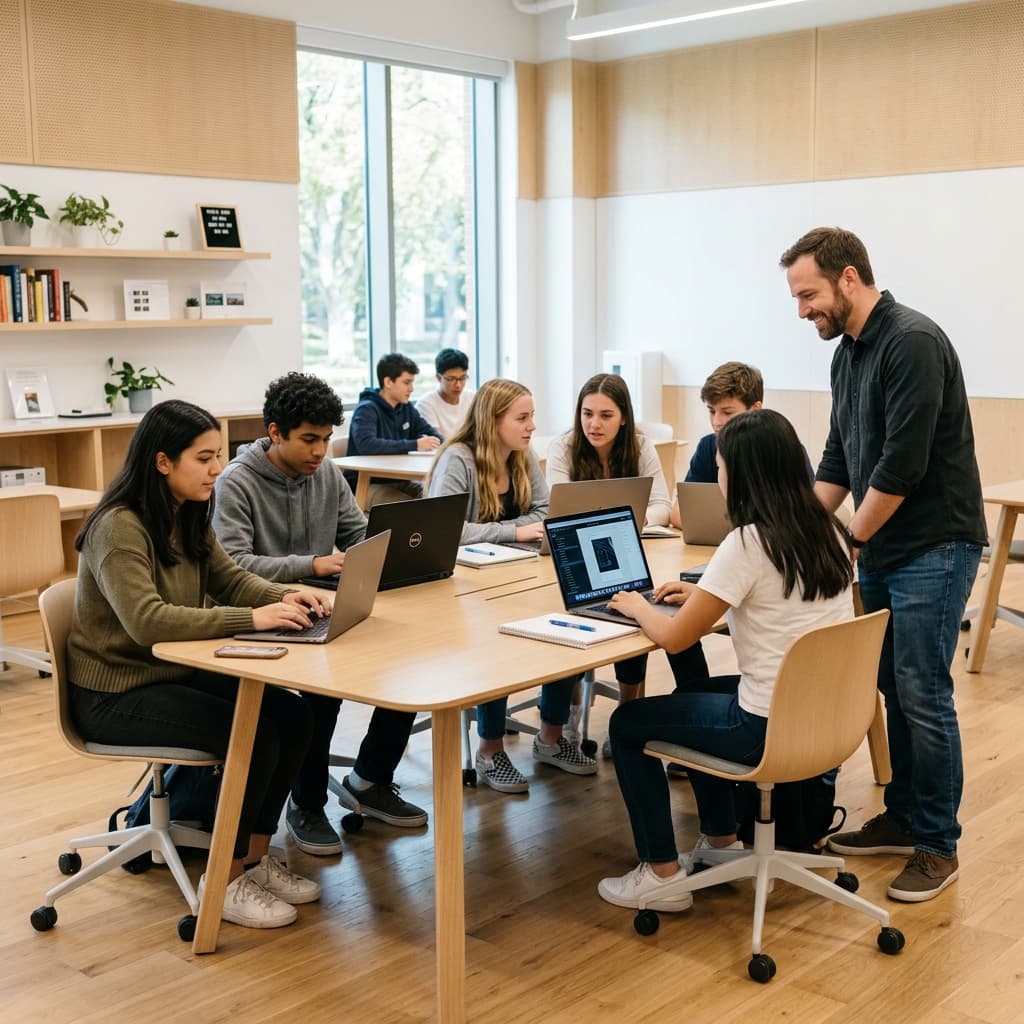
Alpha departs from the conventional school model in several ways. It uses a short daily academic block rather than a conventional full-day sequence of teacher-led classes. It describes adults in the school as guides who support motivation, emotional needs, life-skills learning, and student progress rather than primarily delivering lessons. It also says students work through core subjects using adaptive technology that is intended to personalize pacing and feedback.
KUT reported that Alpha students do their academic work in two hours using an AI program that personalizes content to student strengths and weaknesses, then spend the afternoon on life-skills checklists, entrepreneurship, AI use, or high-school "masterpiece" projects. KUT also reported that students do not have homework or regular teachers in the conventional sense, with guides serving as daily motivators and models for life skills.
What makes it innovative
Alpha's innovation claim centers on using AI and adaptive software to compress core academic work. Alpha says its 2 Hour Learning model uses adaptive technology to provide one-to-one learning, accelerate mastery of core subjects, and return time for real-world skills and interests.
Alpha's own blog describes a mastery-based model in which students move through individualized digital lessons and advance after reaching a stated mastery threshold. It also states that Alpha uses MAP Growth testing and reports average growth above U.S. norms. Those are school-reported claims and should be labeled that way unless School Decision obtains independent test records or third-party validation.
How the school day works
Alpha's public materials describe a school day divided between academic work and nonacademic workshops. The morning is devoted to core subjects through adaptive learning. The afternoon is devoted to life skills, public speaking, entrepreneurship, athletics, leadership, and other workshop-style activities.
CBS News reported that students spend two hours in the morning on science, math, and reading while working at their own speed on personalized AI-driven software. CBS also reported that adults in the classroom are called guides rather than teachers and that their job is to encourage and motivate students.
Academics and progress tracking
Alpha's public explanation of progress tracking relies on adaptive software, dashboards, mastery thresholds, and external testing. The school says its platform identifies gaps and generates lessons at each child's level. It also says students advance after reaching at least 90 percent mastery on a topic and that MAP Growth data show above-norm yearly progress.
Those statements should be presented with clear attribution. A parent reading the profile should understand that Alpha reports these outcomes, while School Decision has not independently audited the underlying data. If the production page later includes test claims, it should state whether the data come from Alpha, NWEA MAP reports, a school document, or a third-party evaluator.
Student experience
The student experience described by Alpha is more technology-centered in the morning and more workshop-centered in the afternoon than a conventional school day. The model may appeal to families looking for self-paced academics, shorter academic blocks, fewer conventional lectures, and more time for practical skills.
The same structure raises verification questions. Families should ask how much time students spend on screens, which software programs are used, how adults intervene when a student struggles, whether students receive direct instruction from subject teachers, and how the school balances independence with age-appropriate support.
Costs and admissions
Alpha publishes campus-level tuition on its locations page. The listed tuition varies significantly by market and campus. Alpha Austin and Alpha High were listed at $40,000, Alpha Brownsville at $10,000, Alpha New York at $65,000, and Alpha San Francisco and Alpha Palo Alto at $75,000 as of the last review date for this content bundle.
Because tuition, grade span, campus status, and aid may change, the production profile should direct families to the campus page before relying on any price. The profile should avoid presenting a single national tuition figure.
Public reporting and cautions
Public reporting on Alpha is mixed and should be summarized without editorializing. CBS and KUT described the unusual academic schedule, use of AI-driven software, and guide role. WIRED reported concerns from former families, students, and staff connected to the Brownsville campus, including concerns about software-driven metrics, student pressure, and the substitution of software for teachers.
The profile should not generalize one campus experience to the entire network. It should, however, tell families that campus-level verification is important. Families should ask to visit the specific campus, speak with current families, understand the role and training of guides, review privacy practices, and request clear explanations of how academic progress is measured.
Fit considerations
Alpha may be worth exploring for families who want a highly structured technology-based academic block, a private school environment, and a day that devotes significant time to life skills or nontraditional workshops. The model may require more caution for students who need frequent direct instruction from subject teachers, students who struggle with extended independent screen-based work, or families that want a conventional transcript and classroom structure.
Those are not judgments about the school. They are fit questions tied to the design of the model.
Sources
- Alpha School, https://alpha.school/.
- Alpha School Locations, https://alpha.school/locations/.
- Alpha School, The Two-Hour School Day, https://alpha.school/blog/the-two-hour-school-day-how-ai-tutors-are-redefining-learning-efficiency/.
- KUT Radio, https://www.kut.org/education/2025-08-25/alpha-school-austin-texas-atx-ai-model-private-vouchers-public.
- CBS News, https://www.cbsnews.com/news/alpha-school-artificial-intelligence/.
- WIRED, https://www.wired.com/story/ai-teacher-inside-alpha-school/.